





.png)


"We didn't inherit the business, we borrowed it from future generations."
That sentence rarely appears in shareholder agreements or governance frameworks. Christy Brown, Executive Chair and 5th generation member of the McIlhenny Family (Tabasco) said it at our recent US Client Conference in New Orleans, and it landed in the room the way true things do: quietly and with weight.
What sounds like a philosophical point turns out to be a strategic one, and it separates family businesses that endure across centuries from those that fragment within a generation or two. It is not primarily about capital structure, dividend policy, or even governance design, but rather about how a family understands its relationship to what it has built and to those who will come after.
Why most family businesses don't outlast their founders
The numbers are unsparing. According to the Family Business Institute (FBI), only 30% of family-owned businesses survive into the second generation, 12% reach the third, and a mere 3% make it to the fourth generation and beyond.
The reasons are rarely external. Markets shift, but they shift for everyone. What tends to destroy family businesses from within is slower and harder to name: the erosion of shared purpose, the accumulation of unresolved conflict, and the failure to think far enough ahead.
This is where stewardship comes in, not as a noble ideal but as a practical leadership posture. Family members who operate as stewards see themselves as caretakers of an institution, accountable not just to the people in the room today but also to the generations who will eventually inherit what this one builds or neglects. Research consistently shows this orientation is more common in family firms than in publicly held ones and that it correlates with stronger long-term performance. It is one of the structural reasons why the best family businesses outlast their peers.
Ownership asks the wrong question
Most families don't adopt the ownership mindset out of greed. It's simply the natural response to having built or inherited something of value. It asks: What can the business provide for us today, and how do we protect what we have? Stewardship asks something harder: what do we owe the generations who will come after us? This shift changes everything. It changes how profits are allocated. It changes who gets developed for leadership and how early. It changes whether difficult conversations are confronted or postponed until someone else has to deal with them.
Families operating from this frame often make decisions that look wrong in the short term. They invest in governance infrastructure before any crisis demands it. They prepare the next generation before anyone thinks they are ready. They build institutional memory before anyone thinks to ask for it. These look like inefficiencies until the generation that skipped those investments faces a transition with no foundation under them.
Thinking beyond your grandchildren
One of the most striking moments at our conference came from an approach used by one of the world's largest family businesses : don't think about the generations currently alive. Not your children, not your grandchildren. Think about the ones after that.
This is deliberately uncomfortable. It forces decision-makers out of the familiar emotional territory of planning for people they know and love into something more abstract but more rigorous. It is the difference between personalized succession planning and institutional thinking.
As family enterprises grow across generations, the family itself becomes larger, more dispersed, and less naturally cohesive. Cousins do not automatically know each other. The shared sense of what the family stands for does not transmit through proximity alone. It has to be built, maintained, and passed on with intention.
Christy Brown, from the McIlhenny Family (Tabasco), shared at our conference that they employ a full-time historian for exactly this purpose: to help family members across generations speak a common language, share a common story, and see themselves as custodians of something larger than the business itself.
The North Star: fixed by design
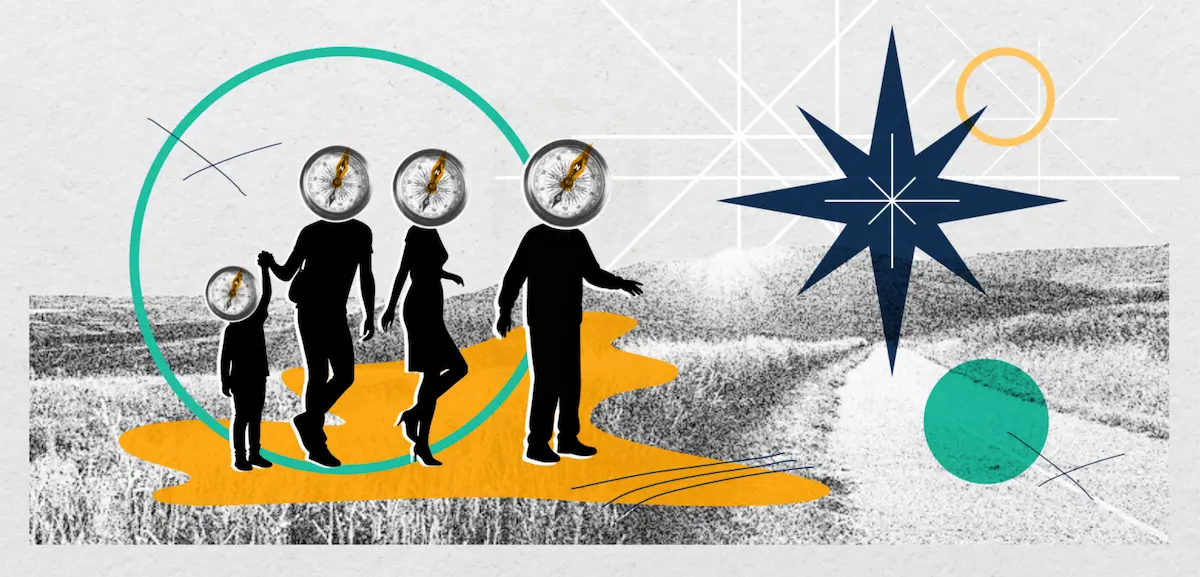
Closely linked to stewardship is the concept of the North Star, a long-term articulation of what the family stands for and what the business ultimately serves. As fellow speaker Stephan Roche (Managing Partner at BanyanGlobal Family Business Advisors) : "The North Star ensures the continuity of the business. It should be static. That's the concept. But it doesn't mean you can't change it if it no longer resonates with your purpose. It should be reviewed, at most, every five years. If you change it more often than that, is it really a North Star?"
This cuts against a business culture that prizes agility and constant reinvention. But for family enterprises, the ability to pivot quickly matters far less than the ability to remain coherent over time. A North Star is not a strategy. It sits above strategy. It is the fixed point against which strategies are tested and decisions are measured.
Stewardship requires both holding on and letting go. Clinging to the past can be as damaging as reckless modernization. The North Star provides the stability that makes that balance possible: it defines what must not change so that everything else can.
What this looks like in practice
The gap between intention and action is one of the most persistent findings in family business research. PwC's 2025 Family Business Survey found that 72% of family business leaders want to keep the business in the family. Only 34% have a formal plan to make that happen.
The families that navigate generational transitions well are almost always those that built their governance infrastructure early, not in response to a crisis, but as a deliberate act of stewardship before one was needed.
Preparing the next generation requires the same intentionality.
The McIlhenny Family runs a program they call "Sauce Camps": three weeks of intensive, demanding work designed to forge bonds between cousins and test their resilience, with internship access for those who complete it. The specific format matters less than the principle. Competence and commitment do not emerge on their own, building them takes deliberate effort, and most families underestimate how much.
Institutional memory works the same way. Family mission statements, constitutions, and governance protocols are not administrative exercises. They are the mechanisms through which a culture gets transmitted from one generation to the next. Without them, each generation has to reconstruct from scratch what the previous one already worked out.
A different measure of success
The families that have endured across three, four, five or more generations share a particular logic. They did not just manage a business. They tended an institution. They did not just plan for their children. They thought about the generations they would never meet.
Measuring success this way is a high standard. It demands long-term thinking when most incentives push in the opposite direction. It requires investing in things that resist easy quantification: identity, culture, shared purpose, the slow work of keeping a family coherent across time and distance.
As Christy Brown (McIlhenny Family) put it simply: "We're not owners. We're borrowers. We're stewards for the next generation."
That may be the most honest definition of what it means to run a family business.
![La charte familiale qui rassemble les générations [Résumé de webinaire]](https://cdn.prod.website-files.com/67490a3a2bcd45d4330ca4bf/6a439adea7e2eb3226ad72b4_TF-ELB%20Conseil-la%20charte%20familiale.png)
![Wealth Mindset: Insights from Global Next-Gen Leaders on Impact, Legacy and Responsibility [Webinar Recap]](https://cdn.prod.website-files.com/67490a3a2bcd45d4330ca4bf/6a32a8fffdc47887b38ba319_BANNER-WEBINARTHUMBNAIL%20(2).png)
.png)