









.png)


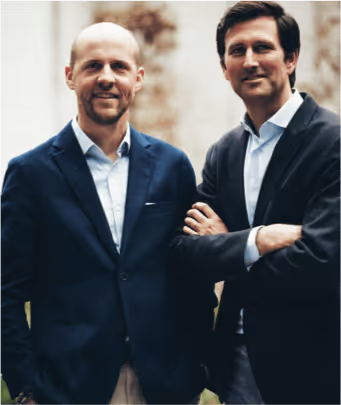



In this first session of our new Next Gen Education Series, Claudia Gómez, Trusted Family's Head of Latin America, welcomed Dr. Matt Allen, John L. Ward Clinical Professor of Family Enterprises and Executive Director of the Ward Center for Family Enterprises at Northwestern University's Kellogg School of Management. Drawing on families in Kellogg's Governing Family Enterprises program, many of them in their third generation or beyond, he explained why established families so often build governance around their fears rather than their hopes.
His talk built on the article he co-wrote with Rob Lachenauer, 10 Warning Signs Your Family Enterprise Governance Is Stuck in Defense Mode. Below are six ideas from the conversation, each followed by a question for your own family.
Governance can help a family avoid problems. Its higher purpose is to help that family accomplish something.
Governance as alignment, and the family council that came too early
Professor Matt Allen opened with a simple premise: governance is a process of alignment between family, ownership, and management, and between the enterprise and its strategy. Families lose sight of this when a structure becomes the goal. When a family tells him it needs a protocol, a council, or a family office, he asks why. If the answer is that a consultant recommended it or that friends have one, the family is not thinking about alignment.
He also warned that the models families rely on are static. The three-circle model always shows equal circles with identical overlap, yet a first-generation business has owner and manager as one person, and the circles only pull apart around the third or fourth generation. His answer is the Goldilocks principle: put structures in place a little before they are needed. A council created for eight relatives, who could simply meet around the dinner table, tends to wither. When the family reaches thirty members and genuinely needs one, the response is that they already tried it and it did not work.
Why families drift toward defense
Professor Allen's central argument rests on negativity bias. When offered an equal chance to gain or lose $20, most people focus on the loss. Families bring the same instinct to governance, so most provisions in a shareholder agreement or family protocol exist to stop bad things from happening.
Defensive governance is essential, he stressed. The problem is having only defensive governance. No one would run a business with 90% of its strategic effort spent on defense, yet many families govern themselves that way. The ten warning signs in his article, from secretive communication to leaders who will not step aside, mean little in isolation. Several together reveal a family's governance philosophy.
The employment policy written for one cousin
Allen's best example of defensive governance is the family employment policy. Families compete over whose is strictest: two years of outside experience, then five plus a master's degree, then competitive entry. The purpose is always the same: to keep out the one cousin everyone knows should never work in the business. Yet the number one concern these families bring to Kellogg is next-generation engagement, and a policy that delays entry until 30 or 35 makes that problem worse. It also creates a stalemate, with the next generation waiting for an invitation and the senior generation waiting for proof.
His alternative is to open doors early and close them later. Tours, internships, access to management, and a couple of years of work after graduation should all get a yes, with the strict criteria applied to those who want to stay and lead. Young people form a connection with the business, and the senior generation gets to observe them. He described one family that set aside its own five-year rule to bring in a 22-year-old relative with AI expertise the company needed.
Exit doors and married-ins
Two signs draw the most pushback from families. The first is a shareholder agreement that prevents owners from ever selling. Meant to protect unity, it can leave a branch of the family that resents the business for generations. In the Q&A, Allen outlined how families make exit workable: shares sold at a discount that reflects minority ownership, a single annual window after an outside valuation, caps on how much can be sold in a year, company buybacks, and rules that stop any buyer from assembling a majority. The right design depends on whether the family's greater concern is liquidity or control.
The second is excluding in-laws. A spouse is an in-law for only one generation, and their children are blood family. Exclude the spouse entirely, Professor Allen argued, and do not expect them to raise children who feel positively about the business. He cited a fourth-generation family that had always excluded in-laws and recently chose to change that policy for strategic reasons.
Candor, listening, and the senior voice that speaks last
A family that claims to have no conflict, Allen said, is usually a family where conflict is not allowed to surface, and changing that takes years. His suggestions were practical. The senior person should speak last, because a leader who announces opposition before asking for views will hear only agreement. Families can assign members to argue for and against a decision, generate three more solutions before closing a problem, and respond to new ideas with thanks rather than dismissal.
On wealth, he argued that hiding it from children does not work, since they can search the family online and already have a sense of what the business is worth. Start early and pair the numbers with responsibility, showing them the employees and customers who depend on the company. On communication, he urged families to use every available channel. But the thing that makes members feel most informed, he said, is leaders who listen.
Governing for entrepreneurship
Professor Allen sees entrepreneurship as a key success factor across generations, and he cautions against governance that only protects the golden goose. The average family business owns 6.5 entities, and today's side venture may become tomorrow's core. Asked by Claudia about family offices that invest in new ventures, he endorsed the approach, along with innovation funds and earmarked profits, while stressing that the family's philosophy matters as much as the structure.
He closed with a family whose non-compete allows a member who starts a business to draw up to 80% of its revenue from the core company, provided 20% comes from outside customers. The goal is a next generation that is independent of dividends, which gives the core business more freedom to grow. He also described a family that held an education session on why lower dividends today could mean higher dividends tomorrow if the money is invested in what comes next.
What this conversation teaches us about governance
Defensive governance rarely feels defensive from the inside. Each rule has a reason behind it, and taken one at a time, every provision looks prudent. Taken together, they can describe a family organized around what it fears.
Matt's message was that families should apply to their governance the same thinking they apply to their businesses: play both defense and offense, and keep adjusting as circumstances change. Governance put in place for one generation will not automatically serve the next.
For families who already have governance in place, one question is worth carrying forward. Is your governance still aligned with what your family hopes to accomplish today?
If you missed the live webinar or would like to revisit specific sections, the recording is available on the Trusted Family website.
Watch the recordingJoin us for the next sessions of our Next Gen Education Series.
Register for the series
![Governing Against Our Fears: Dr. Matt Allen on Why Family Governance Gets Stuck in Defense Mode [Webinar Recap]](https://cdn.prod.website-files.com/67490a3a2bcd45d4330ca4bf/6ac506b22f60fa59ea933ed3_30-09-Matt%20Allen-Is%20your%20family%20governance%20playing%20offense%20or%20defense.png)
![La charte familiale qui rassemble les générations [Résumé de webinaire]](https://cdn.prod.website-files.com/67490a3a2bcd45d4330ca4bf/6a439adea7e2eb3226ad72b4_TF-ELB%20Conseil-la%20charte%20familiale.png)
![Wealth Mindset: Insights from Global Next-Gen Leaders on Impact, Legacy and Responsibility [Webinar Recap]](https://cdn.prod.website-files.com/67490a3a2bcd45d4330ca4bf/6a32a8fffdc47887b38ba319_BANNER-WEBINARTHUMBNAIL%20(2).png)